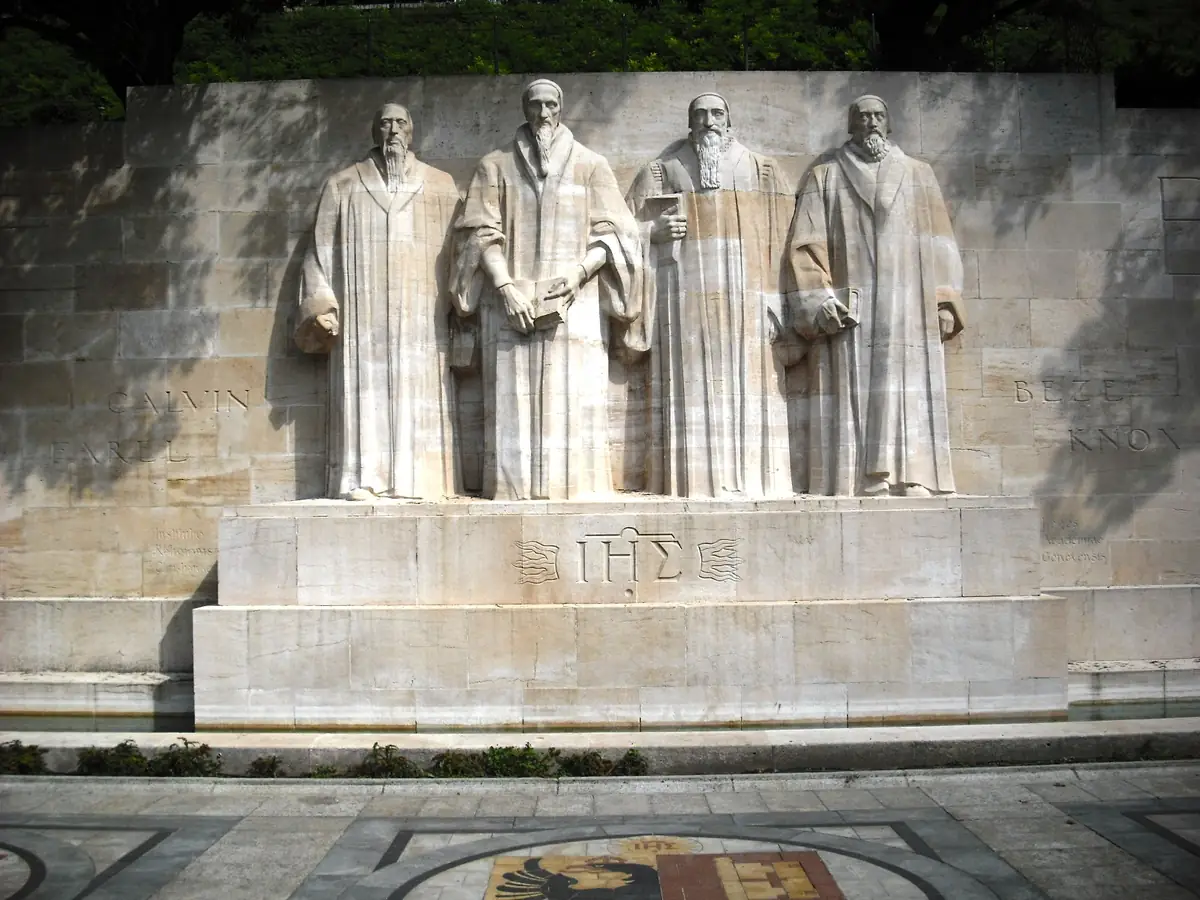

If you walk through the Parc des Bastions in Geneva, beneath the old city walls, you come to a long stone monument. It is about a hundred meters wide, with four towering figures at its center: William Farel, John Calvin, Theodore Beza, and John Knox. Above them, cut in letters taller than a person, are four Latin words: POST TENEBRAS LUX. After darkness, light.
The Reformation Wall was begun in 1909, the four hundredth anniversary of Calvin’s birth and the three hundred fiftieth of the Genevan Academy. But the motto is far older than the monument, and older than the Reformation itself.
A line from Job
The phrase comes from the Latin Vulgate of Job 17:12. In the middle of his anguish, Job complains that his comforters turn night into day. The Vulgate renders part of the verse post tenebras spero lucem: “after darkness I hope for light.”
Before the Reformation reached it, Geneva had already taken this line as its civic motto. It was in use by the 1520s and appears on a city seal from 1530. In December 1535 the council ordered it struck on the city’s coins. It was a wistful hope: light would come someday, perhaps.
Then something happened that changed the sentence. In the early 1540s, a few years after Geneva embraced the Reformation, the motto was shortened. The word spero, “I hope,” fell away, and what remained was a statement of fact: Post tenebras lux. After darkness, light. The Genevans believed the light had come, and that it had come through the open Bible.
A city that voted for the gospel
That conviction was hard-won. Geneva in the early 1530s was a small, restless city. It was struggling free from its prince-bishop and the Duke of Savoy and leaning on its alliance with Protestant Bern. The fiery preacher William Farel had been stirring the city for several years. On May 21, 1536, the General Council of citizens formally voted to “live according to the Gospel and the Word of God.”
A vote, however, does not make a church. That summer a young French scholar named John Calvin passed through Geneva, meaning to stay one night on his way to a quiet life of study in Strasbourg. Farel found him and warned that God would curse his studies if he refused to stay and help. Calvin later wrote that he felt as though God had stretched out his hand from heaven to stop him. He stayed.
The early years did not go well. In 1538 the city council expelled Calvin and Farel. Calvin spent three happy, fruitful years pastoring French refugees in Strasbourg. In 1541 Geneva asked him to come back, and he did, reluctantly. Almost at once he drafted the Ecclesiastical Ordinances, which organized the church under four offices: pastors, doctors (teachers), elders, and deacons.
What the light looked like
For Geneva, “light” was not an abstraction. It looked like the Word of God preached in the language of the people, many times a week. It looked like congregations singing the Psalms. The Genevan Psalter, completed in 1562, gave the Reformed churches tunes they still sing, including the melody we know as the “Old Hundredth.” It looked like a school. The Genevan Academy opened in 1559 with Beza as its first rector and trained pastors who carried the gospel back to France, the Netherlands, Scotland, and beyond.
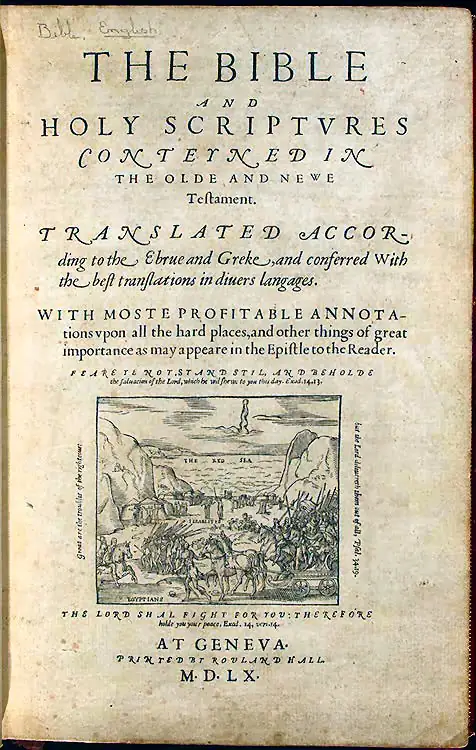
It also looked like refuge. Thousands of persecuted Protestants poured into the city. Among them were English and Scottish exiles fleeing Mary Tudor. In Geneva they produced the Geneva Bible of 1560, the English Bible of Shakespeare, of John Bunyan, and of many of the Pilgrims. One of those exiles, John Knox, wrote home that Geneva was “the most perfect school of Christ that ever was in the earth since the days of the Apostles.”

Geneva was not paradise, of course. It had its quarrels, its harshness, and its sins, as every city does. But its people grasped something essential. Darkness is not driven out by better management or brighter ideas. It is driven out when God speaks.
The older story behind the motto
That is, after all, how the Bible begins. “The earth was without form and void, and darkness was over the face of the deep.” Then God spoke: “Let there be light” (Genesis 1:2–3, ESV). The pattern of light breaking into darkness runs through the whole story. It is there in the pillar of fire in the Exodus, and in the lamp that burned before the LORD in the tabernacle. It is there in Isaiah’s promise that “the people who walked in darkness have seen a great light” (Isaiah 9:2, ESV).
Paul ties the threads together: the God who said, “Let light shine out of darkness,” has shone in our hearts “to give the light of the knowledge of the glory of God in the face of Jesus Christ” (2 Corinthians 4:6, ESV). New creation begins the same way the first creation did, with God speaking light into darkness.
That is why Post Tenebras Lux is more than a Reformation slogan. It is the shape of every Christian’s story. We were in darkness, and God said, “Let there be light,” in the face of his Son. On Reformation Day, and every Lord’s Day, we remember that the light has come. And one day, in the city that needs no sun because the Lamb is its lamp (Revelation 21:23), the darkness will be gone for good.
Soli Deo gloria.